
Analyzing Kickstarter Trends
Insights for Entrepreneurs and Kickstarter Staff

Introduction
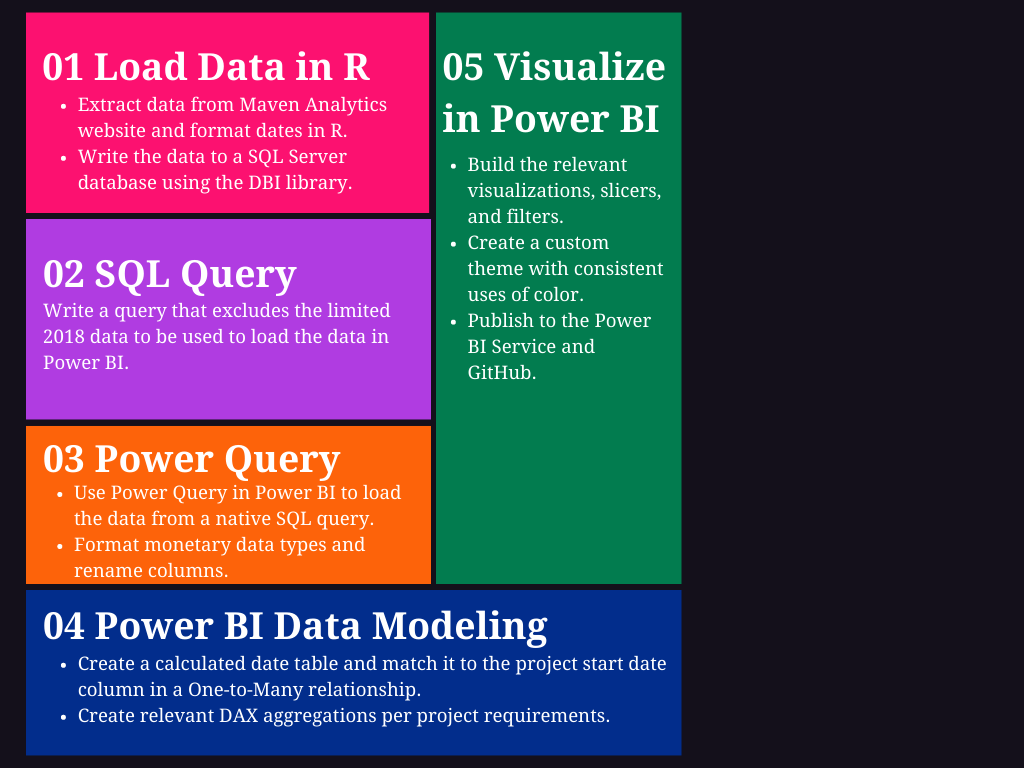
Kickstarter is a popular crowdfunding platform that has revolutionized the space and been a catalyst for numerous innovative projects to come to life. Previously, I utilized a Kickstarter open dataset from Maven Analytics with Tableau to inform prospective founders and Kickstarter staff on the performance of different products on the platform. I am now revisiting this analysis using R, SQL Server, and Power BI to improve on my previous work. The visualizations can be viewed via the PBIX in the GitHub or the PDF below.
Associated Links

Process Flow
Project Requirements and Solutions
Identifying the Most Successful Category: The "Dance" category emerged as the most successful, with an impressive success rate of 62.1% for projects completed between 2009 and 2017. This category encompasses performances, studios, residencies, and workshops, and it consistently ranked among the top 5 categories by year. During this period, a total of 3,767 dance projects successfully reached their funding goals.
The Highest Goal Completion Percentage: Among projects with a goal over $1,000 USD, the Tabletop Game "Exploding Kittens" stood out with an astounding goal completion percentage of 87,825.72%. This means the project received $8,782,572 in pledged funds, far exceeding its initial funding target. This success story demonstrates the potential for projects with unique and engaging concepts to capture the interest of backers.
Trends in Project Success Rates: The analysis revealed a dip in overall success rates between 2014 and 2016. This was primarily due to the saturation of the platform with new projects. This influx of new campaigns made it challenging for projects to stand out and secure adequate funding. However, the situation stabilized in 2017, and the average success rate of projects began to show signs of improvement.
Factors for Future Success: For entrepreneurs looking to maximize their chances of success, the analysis suggests several key factors. Projects with four-figure goals in the range of $1000-$9999 performed exceptionally well relative to other goal amount subsets. Additionally, targeting Kickstarter's more liquid markets in English-speaking countries could be beneficial since there are more backers in these regions. Focusing on high-performing niches that depend on product delivery, such as Comics and Games, rather than performance or talent-based categories like Dance, Theater, Music, and Film & Video, may optimize the success of a crowdfunding venture.